
What Clinton County Property Tax Records Show
Every Clinton County tax record rests on a few key fields. Copy the municipality, parcel number, source date, owner field, and recording reference exactly as they appear. Then compare the annual assessment record against the newest County Clerk instrument. Do this before trusting either one alone. For records that are not posted online, the official custodian is the right stop.
| Field | What It Shows | Where |
|---|---|---|
| Assessed value | Roll value before rates and exemptions | County Real Property and local assessor |
| Market / appraised value | Value derived with the assessment level | County Real Property and local assessor |
| Exemptions | STAR, senior, veteran, and local-option entries | County Real Property and local assessor |
| Tax bill & status | Billed, paid, or delinquent status | County Treasurer or municipal collector |
| Taxing districts | Municipal, school, and special districts | County Treasurer or municipal collector |
Accuracy starts with faithful copying. In Clinton County, write down the municipality, parcel number, and source date. Add the owner of record and the recording reference. Do not paraphrase any of these. Set the annual assessment record beside the most recent County Clerk instrument. When a record is not online, the official custodian can supply it.
Looking Up a Clinton County Tax Bill
A Clinton County tax bill lookup works best with exact identifiers. Bring the municipality and the parcel number. Bring the source date, the owner field, and the recording reference, all copied precisely. Check the annual assessment record against the newest County Clerk instrument. Records missing from the web live with the official custodian, who responds to direct requests.
- Find the Clinton County parcel by address and confirm its municipality. by address or parcel]
- Copy the complete tax-map number and the dated owner field.
- Compare the newest deed, grantee, legal description, and recording date.
- Check the correct tax year and map context with the official office.
- Assessed value
- The value entered on the assessment roll before tax rates are applied.
- Tax rate / levy
- The taxing jurisdiction's rate or amount, distinct from the assessment.
- Exemption
- An authorized reduction reflected in the applicable taxable-value column.
- Tax lien
- A claim associated with unpaid property taxes and enforcement.
Appealing a Clinton County Assessment
Before appealing anything in Clinton County, get the details right. The municipality, parcel number, source date, owner field, and recording reference should be copied exactly. Copy them from the source documents. Compare the annual assessment record with the newest County Clerk instrument. Mismatches matter in a grievance. The official custodian handles records that never appear online.
Appeal window. Use these public records for lawful property research, never harassment, and verify important facts with the custodian. with the Board of Assessment Review; missing the window means waiting for the next cycle.]
Read the Clinton County Roll Before the Bill
The assessment roll comes first. It identifies the tax-map parcel, the property location, the current owner's name, and the mailing address. It also lists the land assessment, the total assessment, exemption entries, taxable values, and the taxing districts. Those fields set the base for every later tax record. The roll itself is not the bill. The 2026 Plattsburgh City roll uses a July 1, 2025 valuation date and a March 1, 2026 taxable-status date. So name the roll year and dates in any comparison.
Land, total, exemption, and taxable value sit under separate headings. An exemption can reduce taxable value for a stated purpose. It leaves the underlying assessment untouched. District columns place the parcel in its municipal, school, or special-district context.
Use the Correct Clinton County Tax Collector
County Real Property links the rolls, the rates, and collector information in one place. The Treasurer collects delinquent taxes for county-administered jurisdictions. City of Plattsburgh tax administration is a documented exception to that program, which otherwise covers the fourteen towns, three villages, and nine school districts. Confirm the municipality first. Then ask whether a bill is current, paid, delinquent, or subject to enforcement.
Open the official Clinton County assessment and tax-information page for the county's own links.
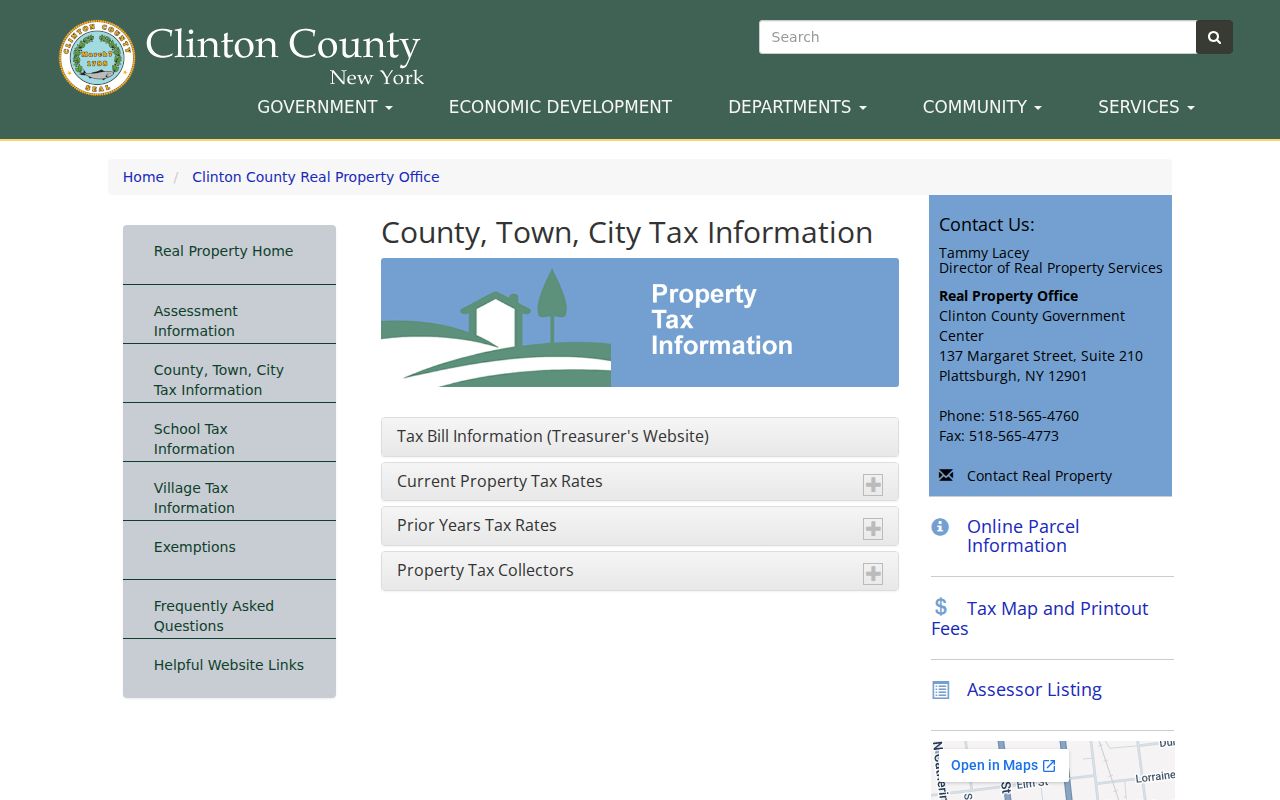
That official page routes visitors to county material, while the responsible collector confirms a parcel's live balance and receipt.
Understand the Retired Clinton Tax Browser
The legacy tax browser had quirks worth remembering. Users were told to omit the 09XXXX SWIS prefix when entering a Parcel ID. They were also told to avoid combining owner and parcel searches. County material now calls that system old and no longer used. No successor interface has replaced it in public documentation. Treat those instructions as historical behavior tied to one retired tool. They were never a universal parcel rule.
Review the legacy Clinton County tax-bill browser for its original instructions.
Current bills, balances, payment methods, and receipts require confirmation with the Treasurer or the proper municipal collector.
Assessment Level Is Not Individual Accuracy
New York's level of assessment relates assessed totals to market-level estimates. Its equalization-rate system helps taxing jurisdictions compare themselves fairly. A rate is a municipal measure, nothing more. It does not prove that one parcel's assessment is accurate. The 2026 Plattsburgh City roll states a 100 percent uniform percent of value. That roll is presented at its stated full-value level.
A parcel owner should still compare the subject property's characteristics and relevant evidence. A municipality-wide percentage cannot substitute for parcel-specific analysis or a private appraisal.
Read STAR, Senior, and Veteran Entries
Exemption codes and taxable-value columns prove that an adjustment was applied, but eligibility and benefit vary by program and taxing purpose. New York publishes forms for STAR relief, senior-citizen exemptions, veteran exemptions, and other programs. Some are local options. All require an application by the applicable deadline.
Read no private circumstances into the public roll. For a correction or a new application, contact the assessor and use the current state form. An exemption never changes ownership.
Challenge an Assessment With RP-524
New York's RP-524 grievance targets the current tentative roll. File the complaint with the assessor or the Board of Assessment Review on the local calendar. State guidance says there is no filing fee. Identify the parcel, the stated assessment, the requested assessment, the grounds, and the supporting evidence.
A clerical bill issue belongs with the collector. Valuation and classification disputes follow the assessment process instead. Confirm the tentative-roll and grievance dates locally rather than assuming one statewide deadline.
Clinton County Delinquency and In-Rem Timing
The Treasurer's material describes a two-year delinquent-tax period that can lead to in-rem foreclosure. Redemption and payment-plan routes remain subject to published terms. Current material names January 5, 2027 as a deadline for specified delinquent years and arrangements. Tie that date to the actual notice and the years it covers. Never apply it to every parcel.
Gather the bill years, installments, charges, payments, redemption status, and any filed foreclosure record. A delinquent list alone is not proof that title has transferred.
Save Clinton County Tax Evidence by Year
Keep each piece of Clinton County tax evidence separate and dated. Save each piece as its own record. Keep the roll page, the bill, any receipt, the rate source, the collector reply, and the delinquency status together in that file. For each one, note the municipality, tax-map number, and situs. Add the owner field, tax year, districts, and query date as well. That discipline keeps a 2025 assessment from blending into a 2026 bill. It also keeps a town parcel from being charged to a city collector.
Old roll links may shift over time. The county publishes no single official district trend series that fits every parcel. Compare matching fields across actual roll years instead. Flag any exemption or parcel-number changes you see along the way.
Distinguish Tax Status From Ownership
A paid Clinton County tax bill does not make someone the titled owner. The person the bill is mailed to may not live there either. Match the bill to the tax-map parcel and municipality first. Then lean on the dated roll owner. Use the newest recorded deed for any ownership research.
An assessment is not an appraisal. A delinquency notice is not proof that foreclosure moved title. Keep these sources apart. A plain tax fact will not harden into an ownership claim nobody can back up.