
Clinton County Deed Records and What They Show
Pulling useful facts out of a deed takes careful copying. Write down the municipality. Record the parcel number, the source date, and the owner field exactly as written. Add the recording reference too. That combination lets you match the annual assessment record against the newest instrument. That instrument gets filed with the County Clerk. Anything missing from the online record can still be requested from the official custodian. A gap online is never a dead end.
| Deed Type | What It Does | Common Use |
|---|---|---|
| Warranty deed | Conveys the stated estate with deed covenants | Conventional arm.s-length transfers |
| Quitclaim deed | Conveys only the grantor.s existing interest | Family transfers and title cleanup |
| Grant / special warranty | Covenants are limited by the deed terms | Transactions using limited covenants |
| Trustee / executor deed | Fiduciary conveys under documented authority | Estate and fiduciary transfers |
| Tax deed | Conveys an interest after tax enforcement | Recorded tax-enforcement conveyance |
Details matter when you read a deed. Copy the municipality, parcel number, owner field, and recording reference character for character. Note the source date as well. Then set the assessment record beside the most recent County Clerk instrument. See whether the two agree. Some Clinton County property records never make it online. For those, the custodian of the originals is the office to ask.
The Clinton County Grantor-Grantee Index
Accuracy starts with transcription. Note the municipality, the parcel number, the owner field, and the source date. Copy the recording reference exactly as it appears. A single digit off can send you to the wrong parcel. Comparing the assessment record with the latest recorded instrument confirms you have the right chain. When a document is not posted, contact the county office. That office keeps the originals and can do a lookup.
- Find the Clinton County parcel by address and confirm its municipality.
- Copy the complete tax-map number and the dated owner field.
- Compare the newest deed, grantee, legal description, and recording date.
- Check the correct tax year and map context with the official office.
- Grantor
- The party conveying an interest.
- Grantee
- The party receiving an interest.
- Chain of title
- The linked series of recorded transfers.
- Book/Page vs Instrument #
- The recorded book-page or instrument identifier.
Getting a Copy of a Clinton County Deed
Before ordering a copy, gather your identifiers. List the municipality, the parcel number, the owner of record, the source date, and the recording reference. Copy them exactly. Then check the newest instrument against the assessment record for consistency. Not every Clinton County deed is available online. The office that holds the originals can produce records that never reached the web.
Recorded, not guaranteed. Use these public records for lawful property research, never harassment, and verify important facts with the custodian.
Search Clinton County Deeds in Cott
The Clinton County Clerk posts Cott eSearch as its web index for recorded real-property documents. The county states that coverage runs from 1972 to the present. Start with the current owner's name exactly as the assessment roll spells it. Search that name as a grantee first. That finds the deed through which the owner acquired the parcel. Then run the seller's name as a prior grantee and keep stepping back. The index is built around parties and recorded instruments rather than postal addresses. An everyday street address may get you nowhere. Names, the recording reference, the municipality, and the legal description are what the system rewards. Lean on those fields every time.
| Search clue | How to use it | What to save |
|---|---|---|
| Grantor | Search the person or entity conveying an interest | Exact indexed spelling and role |
| Grantee | Search the person or entity receiving an interest | Vesting names and deed type |
| Recording date | Sort or compare nearby filings | Date and sequence of instruments |
| Book-page or document number | Retrieve the indexed instrument | Complete reference, including punctuation |
| Legal description | Confirm that successive deeds concern the same land | Lot, block, map, acreage, bounds, and prior deed |
A no-result search does not mean no Clinton County deed exists. Try surname variants and initials. Try former entity names, trustees, and executors. Look at the names printed inside the latest instrument you did find, since a deed may be recorded under a party's formal or legal styling rather than the everyday version. The county does not document every search control or image setting for visitors who are not logged in, so confirm current search options and image access rather than assuming fields the county has never described.
Clinton County Deed Records Before 1972
The online cutoff is not where Clinton County land history begins. A FamilySearch catalog entry describes deed books covering 1801 through 1901. General indexes reach from 1799 through 1920. Some images may require a sign-in or carry access restrictions. So treat the catalog title as a finding aid rather than a guarantee that every page can be viewed from home. When Cott does not reach far enough, the fallback chain begins. The County Clerk counter, older books, local archives, and special collections form that chain. A 2019 county resolution adds useful detail. It describes Cott backfile work on a general deed index for 1972 through 1984. Deed-record groups around 1963 through 1972 and 1978 through 1984 appear as well. That points to digitization depth near the online cutoff. It does not prove every instrument from those years is indexed or imaged the same way. So ask the Clerk for a specific index or volume when a link in the chain is missing. The historic catalog source shows how the older record set is described. Open the FamilySearch Clinton County land-record catalog. Check the listed deed-book and general-index ranges there. Then plan a visit or a volume request.

Use the catalog listing to plan which volume to request. The deed page itself supplies the parties, the property description, and the recording evidence.
Record Every Link in a Clinton County Chain
For every transfer, record the date, the grantor, the grantee, the deed type, and the reference. The reference may be a book-page or a document number. Add the consideration clue, the municipality, and the full legal description. The description is your control when a street number changes. It is also your control when the index turns up two people who share a name. A lot-and-block description should point to a recorded subdivision map. A metes-and-bounds description should carry bearings, distances, monuments, and calls to adjoining land. Never shorten either one to a postal address in your notes. Work backward from the newest deed you have confirmed. The grantee received the stated interest; the grantor conveyed it. Search that grantor as a grantee in an earlier period. Pull the acquisition deed, and compare the land description before moving on. When an executor, trustee, or estate appears, run both the fiduciary and the decedent names through the index. Consult Surrogate's Court records for the authority behind the transfer. Probate material explains the authority. The later recorded deed still documents the conveyance itself. Splits and mergers can break an otherwise clean chain. Clinton County's 2024 merger form requires common titled ownership, contiguous parcels, and paid taxes. It excludes the Town of Peru. A changed tax-map number is not by itself a transfer. Keep old and new parcel numbers beside the legal descriptions and any recorded map references. That keeps the chain readable.
Copies, Certification, and Clinton County Fees
The County Clerk charges $0.65 per page for ordinary recorded-document copies, with a $1.30 minimum. Certified copies cost $1.25 per page. A $5 minimum applies to those. A recorded map copy runs $6. Cott's online images and prints work through an account or subscription, a different route from ordering at the Clerk's counter. Confirm the total and the delivery method before paying, especially when certification or a large instrument is involved.
A plain copy works fine for reading a deed, matching a description, or extending a chain of title. Certification is the office's own authentication. Some formal purposes require it. It does not insure title, and it does not fix a deed's legal effect. When ordering, give staff the document number or book-page, the record type, the recording date, and the party names. That avoids paying for the wrong record.
Consideration Is a Clue, Not an Appraisal
A Clinton County deed often states consideration. It may also carry transfer-tax information. That number is not automatically the property's market value. Several situations weaken a simple price comparison: transfers between relatives, fiduciary deeds, nominal consideration, exemptions, partial interests, and sales spanning more than one parcel. Record the figure and its notation exactly as written. Then weigh it against the deed terms and the parcel description.
The assessment roll answers a different question. Its land and total assessment fields, exemption entries, and taxable values carry their own stated dates. Neither those figures nor recorded consideration replaces an appraisal for a buyer researching value. A title researcher likewise should not read a dollar amount as proof that the deed conveyed the entire estate.
PropertyCheck Watches New Clinton County Recordings
The Clerk's PropertyCheck service is free. It runs around the clock, and matching recordings trigger text or email alerts after you enter a name. Enter the name exactly as it appears. Initials, entity suffixes, trusts, and spelling variants can each produce different matches. Register important variants only after checking how the names appear in the deed index.
View the official Clinton County PropertyCheck signup.
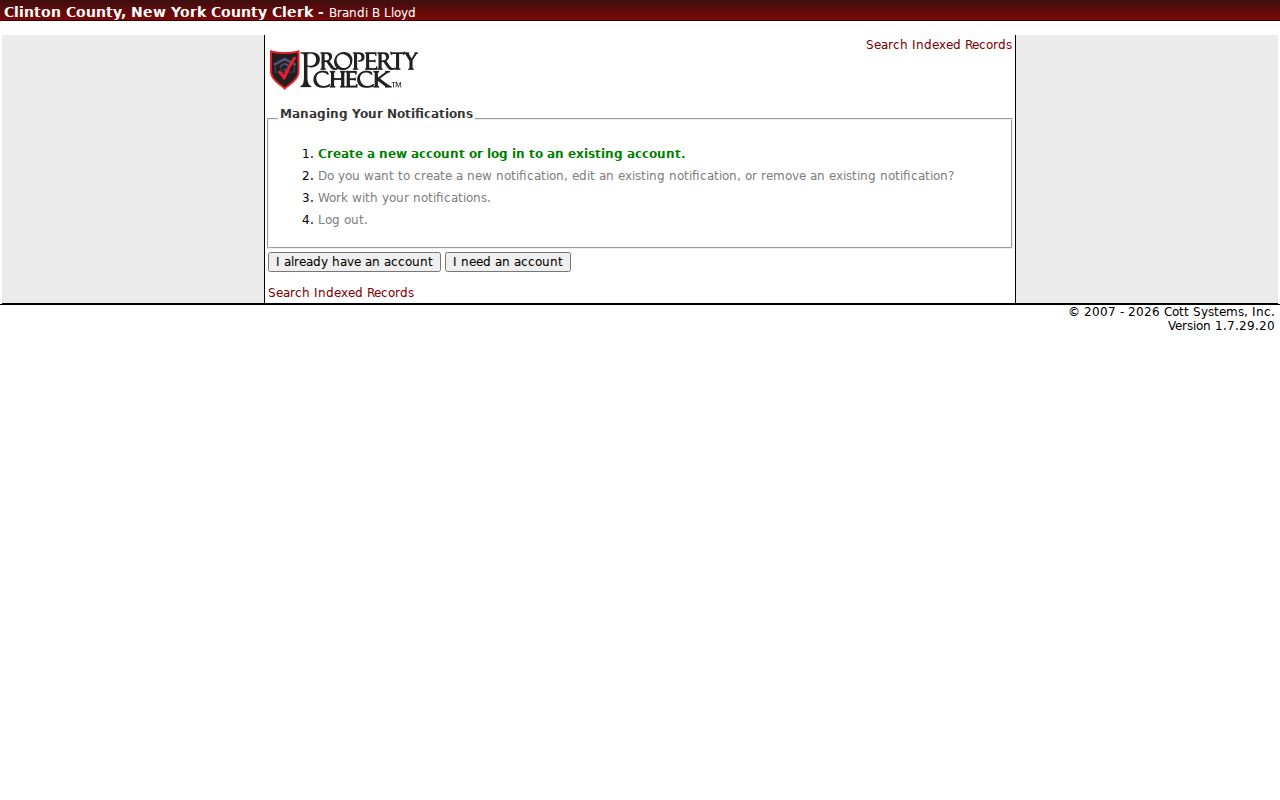
An alert only flags a new name match. It does not prove fraud, cancel an instrument, or certify ownership, so raise any unfamiliar notice with the County Clerk.
Verify the Instrument, Not Just the Index
A complete Clinton County deed-record result includes the retrieved instrument, its recording citation, the matching legal description, and notes on any unresolved party or parcel difference. Index labels stay clues. Dollar fields do too, until the document itself is read.